

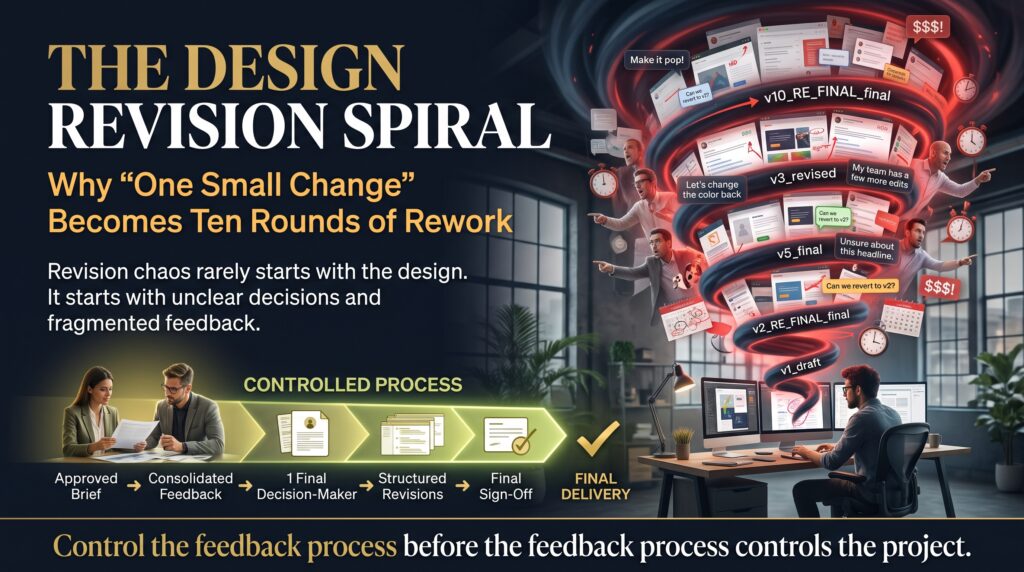
Brand drift is what happens when a business slowly stops looking like itself. Nobody decides to change the logo colour. Nobody votes to stretch the logo a little wider. It happens one flyer, one social post and one proposal at a time, until the website, the invoices, the Instagram feed and the shopfront all look like cousins rather than siblings.
If you have ever opened three pieces of marketing from the same company and wondered whether they came from the same place, you have seen brand drift in action. This guide explains why every new design nudges a business slightly off course, what that costs, how to run a quick brand audit, and a practical system for keeping your visual identity consistent. It is written for business owners, marketers, in-house designers, freelancers and anyone learning graphic design in Australia.
What Is Brand Drift?
Brand drift is the gradual, unplanned change in a brand’s look and feel caused by many small design decisions made without a shared standard. It is different from a deliberate rebrand. A rebrand is a planned change with a clear reason and a rollout. Brand drift is accidental, and usually invisible to the people causing it because each individual piece looks fine on its own.
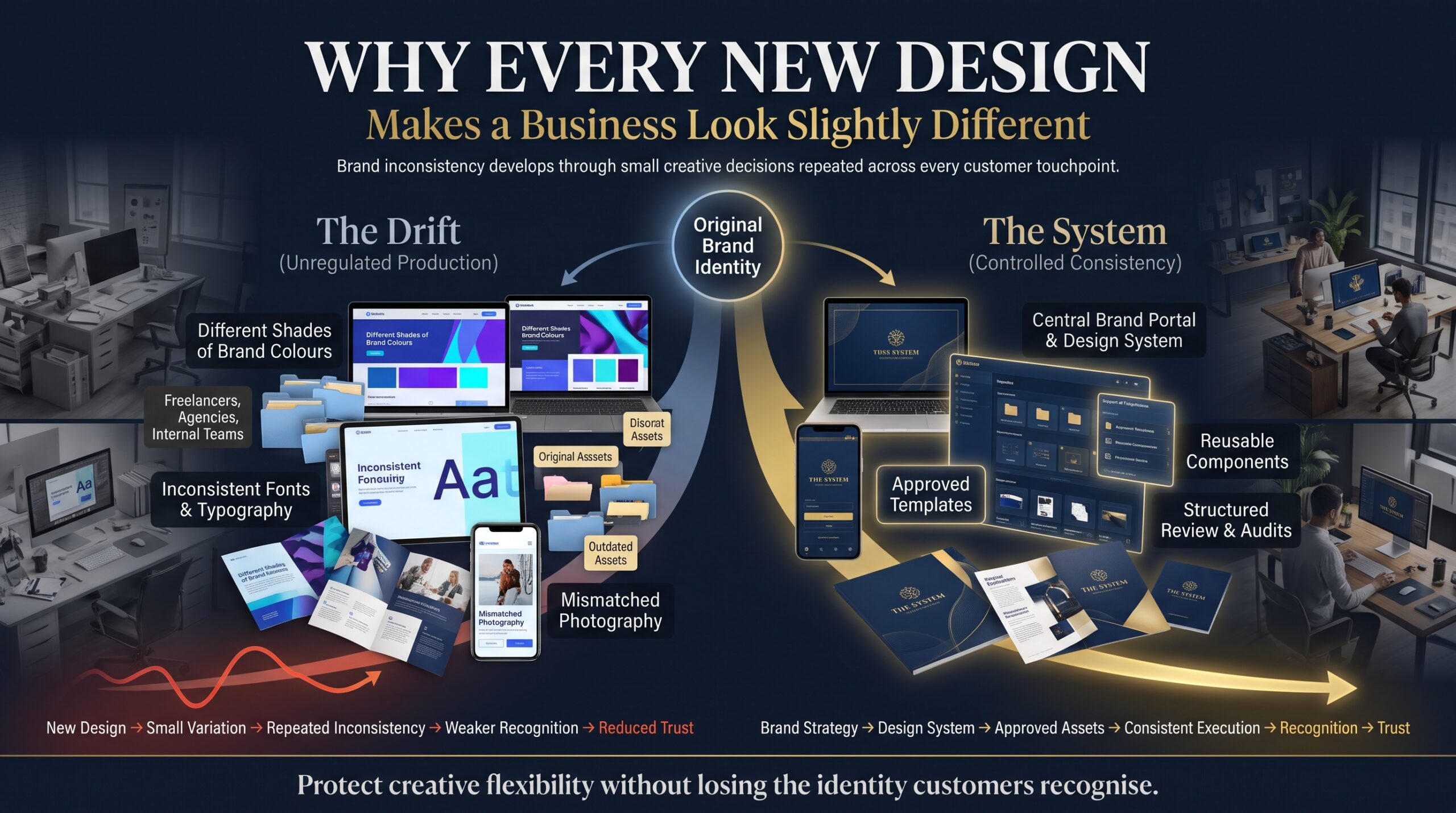
The problem shows up in colours that are almost right, fonts that are close but not identical, logos in slightly different versions and imagery that changes style depending on who picked the photos. The danger is that each piece is judged alone, when customers experience them together.
Why Every New Design Makes a Business Look Slightly Different
Brand drift has a handful of predictable causes. Once you can name them, you can fix them.
1. There is no clear brand guideline, or nobody uses it
Many small businesses never wrote down their rules. Others have a beautiful brand guide sitting in a folder that nobody opens. Without an agreed answer to “which blue, which font, how much space around the logo”, every designer fills the gaps with personal judgement.
2. Too many hands touch the brand
A founder makes a quick post, a marketing coordinator builds an email, a freelancer designs a brochure, an agency runs the ads, and a printer reproduces it all. Each person interprets the brand differently, and each handover adds a small shift.
3. Templates and quick tools pull designs off course
Template-based tools make design fast, which is useful, but templates arrive with their own fonts, colours and layouts. If the brand kit is not locked in, people accept the template’s defaults, and the business starts to look like the template instead of itself.
4. Old files never die
Outdated logos and last year’s colours live on in shared drives, email attachments and old presentations. Someone grabs the first file they find, and a retired version quietly returns to circulation.
5. Colour and format mismatches
A colour that looks right on screen can print differently. HEX, RGB, CMYK and Pantone values are not interchangeable, and a logo exported at the wrong size or with a missing font can change shape. Technical slips are a major engine of brand drift.
6. Every campaign wants to be “fresh”
New campaign, new look is a tempting habit. Each refresh feels creative on its own, but string enough of them together and the brand has no stable face. Customers cannot remember what they cannot recognise.
Where Brand Drift Hides in a Business
| Touchpoint | Typical sign of brand drift | Why it goes unnoticed |
| Website | Buttons and headings in slightly different colours from the logo | Updated by different people over time |
| Social media | Profile images, templates and filters that change every few months | Posts are made quickly, one at a time |
| Invoices and proposals | Old logo version, default fonts, no brand colours | Created by admin or finance, not design |
| Email signatures | Stretched or pixelated logos, mixed fonts | Each person sets up their own |
| Ads | Different styles across platforms and agencies | Teams optimise for clicks, not consistency |
| Print and signage | Colours that do not match the screen version | Printers work from whatever file they receive |
What Brand Drift Costs Your Business
The cost of brand drift is rarely a single invoice. It builds up quietly across several areas.
- Weaker recognition. Marketing research from the Ehrenberg-Bass Institute highlights the value of distinctive brand assets such as colours, logos and shapes that people link to a brand quickly. Drift dilutes those assets.
- Lower trust. Inconsistent visuals can make a business look less established, and people are cautious about businesses that look disorganised.
- Wasted time and money. Designers redo work because files are wrong, approvals drag on, and the team keeps rebuilding what should already exist.
- Poorer ad performance. If every ad looks different, none of them benefit from the memory built by the last one.
- Legal and reputation risk. A logo that is altered, stretched or recoloured is harder to defend. If you want protection for your logo, check the information on trade marks from IP Australia.
Brand Drift Versus Healthy Brand Evolution
Not all change is bad. Brands should evolve. The difference between drift and evolution is intent and control.
| Area | Brand drift | Healthy evolution |
| Decision | Accidental, made by whoever is designing | Deliberate, approved by a brand owner |
| Reason | “It looked nicer on this one” | A clear business or audience reason |
| Rollout | Piece by piece, inconsistent | Planned across all touchpoints |
| Documentation | Nothing updated | Guidelines and files updated first |
| Result | A brand that looks different everywhere | A brand that looks fresh and still recognisable |
How to Fix Brand Drift in 6 Steps
- Run a brand audit. Collect everything: website pages, social posts, invoices, brochures, ads, signage, email signatures. Print or lay them out side by side and score logo, colour, typography, imagery, layout and tone. The gaps are usually obvious within minutes.
- Decide what is fixed and what is flexible. List the non-negotiables, such as logo versions, core colours and primary fonts, and the elements allowed to flex, such as photography treatment or illustration style for specific campaigns.
- Write or update the brand guidelines. Cover logo clear space and minimum size, colour values in HEX, RGB, CMYK and Pantone, typography hierarchy, imagery style, layout grids, tone of voice, and clear do and don’t examples.
- Build the tools people actually use. Create locked templates, shared libraries and master files. Adobe Creative Cloud Libraries, a Canva Brand Kit or a Figma style library put the right assets one click away, so the easy choice is the correct one.
- Train everyone who touches the brand. Staff, freelancers and agencies need a short onboarding briefing. A one-page checklist stops most errors before they leave the building.
- Give the brand an owner and a review rhythm. Someone must approve new designs and run a short audit every quarter. Without ownership, brand drift returns within months.
Design Skills That Stop Brand Drift
Brand consistency is as much a skills problem as a process problem. People who understand design software can build proper master files, templates and style systems instead of improvising. Vector skills help you keep logos crisp at any size, layout skills help you build reusable templates, and image skills keep photography consistent.
| Skill | How it prevents brand drift | Where to learn it |
| Illustrator | Clean vector logos, icons and master brand files that scale without distortion | Illustrator beginner course, intermediate, advanced |
| InDesign | Consistent multi-page layouts, brand templates and style guides | InDesign beginner course, intermediate, advanced |
| Photoshop | Consistent image editing, colour treatment and web graphics | Photoshop beginner course, intermediate, advanced |
You can compare every level on the graphic design courses page, read the FAQs, learn about us or browse the graphic design blog. For the Adobe tools themselves, see Adobe Creative Cloud, and for the wider profession the Australian Graphic Design Association is a useful community. If you also manage campaigns, explore digital marketing agencies and the Logitrain digital marketing course, web-focused learners may like the web development job program.
Brand Drift Across Australian Cities
Every market has its own pressures, and brand drift appears in different forms. Classes run in person in Melbourne, Sydney and Brisbane, and live online or in-house for Adelaide, Canberra and Perth.
| City | Where brand drift often appears | Local course page |
| Sydney | Fast-moving agencies and corporate brands with many stakeholders and suppliers | Graphic design courses Sydney |
| Melbourne | Retail, hospitality and creative businesses working with many freelancers | Graphic design courses Melbourne |
| Brisbane | Growing small businesses and events brands expanding across channels | Graphic design courses Brisbane |
| Perth | Resource and service firms with head-office and site teams producing their own materials | Graphic design courses Perth |
| Adelaide | Small and mid-sized businesses where one person often handles all design | Graphic design courses Adelaide |
| Canberra | Government and associated organisations where style guides must be followed strictly | Graphic design courses Canberra |
Frequently Asked Questions About Brand Drift
What is brand drift?
Brand drift is the slow, unplanned change in a brand’s visual identity caused by many small design decisions made without a shared standard. Logos, colours, fonts and imagery gradually stop matching across touchpoints.
How is brand drift different from a rebrand?
A rebrand is a planned, approved change with a reason and a rollout. Brand drift is accidental. The two can look similar from the outside, but only one is under control.
What causes brand inconsistency?
The usual causes are missing or ignored guidelines, many people creating assets, template defaults, outdated files in circulation, colour and format mismatches, and constantly changing campaign styles.
How do I stop brand drift in a small business?
Start with a simple one-page guide covering your logo, colours and fonts, put approved files in one shared folder, build locked templates, and nominate one person to approve new designs. Review everything quarterly.
What should a brand style guide include?
At minimum: logo versions and clear space, colour values for screen and print, typography rules, imagery style, layout examples, tone of voice and clear do and don’t examples.
Can Canva or templates cause brand drift?
They can if the brand kit is not set up properly. Locking your colours, fonts and logos into the tool, and limiting which templates staff can use, keeps quick designs on brand.
Keep Your Brand Looking Like Itself
Brand drift is not a creative failure. It is what happens when a business grows faster than its design standards. Audit what exists, decide what must stay fixed, give people the right tools and keep one person accountable, and every new design will strengthen the brand instead of nudging it off course. If you want the skills to build that system yourself, explore our graphic design courses, see all locations or contact our team on 1300 649 299.