
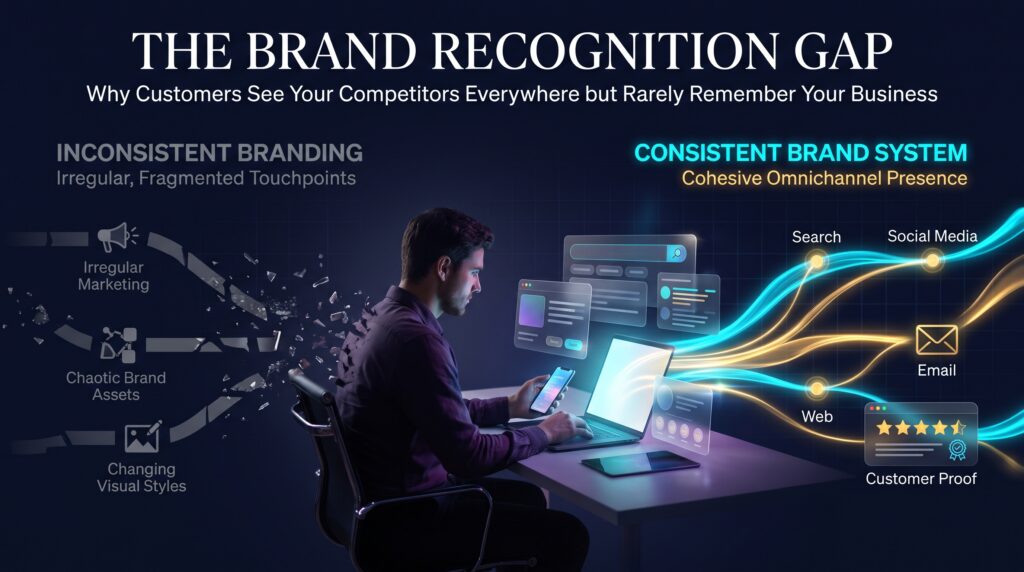


Brand recognition is the difference between a customer scrolling past your business and stopping because they know it is you. Most owners assume the gap is about budget: competitors simply advertise more. In reality, many businesses spend real money on marketing and still fail to be remembered, because every ad, post, flyer and website looks slightly different. Customers see the competitors everywhere, recognise them in half a second, and struggle to recall the name of the business that was actually better.
This guide explains the brand recognition gap in plain language, why it happens, how to measure it and how good visual design closes it. Whether you run a trade business in Brisbane, a boutique agency in Sydney or a café in Adelaide, the principles are the same. If you are a designer, marketer or founder who wants to fix this properly, you will also see which design skills matter most.
Quick answer: the brand recognition gap is the distance between how often customers see your business and how often they correctly remember it. It is caused by inconsistent visuals, generic category cues and the absence of distinctive brand assets, and it is closed by consistent, distinctive design repeated across every touchpoint.
What Is Brand Recognition (And How Is It Different From Brand Recall)?
Brand recognition means customers can identify your brand when they encounter it: a logo on a van, a colour on a shelf, a layout on a social feed. Brand recall is harder. It means they can bring your name to mind without any visual cue, such as when a friend asks “do you know a good accountant?” Both matter, but recognition is usually the first and fastest to build, and it makes recall easier over time.
| Concept | What it means | Everyday example |
|---|---|---|
| Brand awareness | The customer has heard of you | “I think I have seen that name somewhere” |
| Brand recognition | The customer identifies you from cues | Spotting your colour and logo on a crowded shelf |
| Brand recall | The customer remembers you unprompted | Naming you when asked for a local provider |
| Brand preference | The customer picks you over alternatives | Choosing you even when a competitor is cheaper |
Research groups such as the Ehrenberg-Bass Institute for Marketing Science have long argued that brands grow by being easy to notice and easy to recall in buying situations. Whatever your view on the theory, the practical lesson for small and mid-sized Australian businesses is clear: if people cannot recognise you quickly, they cannot choose you.
The Brand Recognition Gap: Why Competitors Seem to Be Everywhere
When a customer says “I see your competitor everywhere”, they are rarely describing a bigger ad budget. They are describing a brand that looks the same wherever it appears. Here are the most common reasons the brand recognition gap opens up.
No distinctive visual asset. Your logo, colours and layouts look like everyone else in the category. If five plumbers use blue and a water drop, none of them is memorable.
Every new design looks different. A new designer, a new template or a new campaign changes the fonts, colours or style. Each change resets customer memory.
The logo fails at small sizes. If your mark is unreadable as a social media avatar, a favicon or a van sticker, it will not be recognised where most people meet it.
Too many colours and typefaces. A palette of eight colours and four fonts signals no clear identity. Customers remember one or two strong cues, not a collage.
Exposure is inconsistent. Brand recognition builds through repeated, similar exposures. Irregular posting, one-off campaigns and abandoned channels break the repetition.
Template reliance. Heavy use of stock templates makes your marketing look like thousands of others. Good templates help speed, but they rarely create distinctiveness on their own.
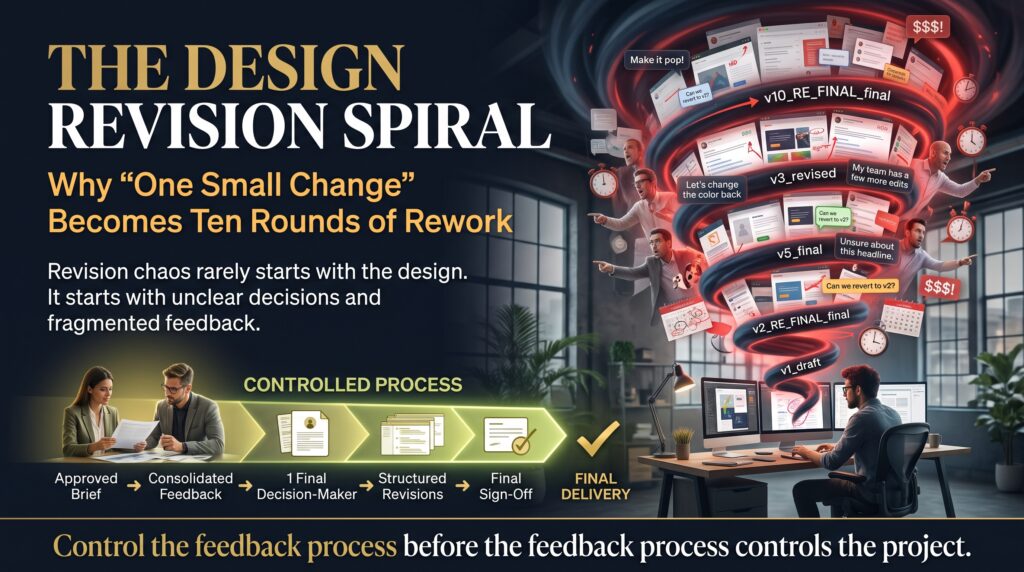
Design by committee. When every stakeholder adds a preference, the result is safe, bland and forgettable.
The Real Cost of Low Brand Recognition
A weak brand recognition position quietly raises your cost of winning every customer. Here is how it shows up in the business:
- Higher ad costs. Unfamiliar brands tend to earn fewer clicks and lower trust, so you pay more to get the same result from Google Ads and social campaigns.
- Lower conversion rates. Customers hesitate when a business looks unfamiliar or inconsistent between its website, email and social profiles.
- Weaker referrals. Happy customers cannot recommend a name they cannot recall.
- Price pressure. Brands that are not remembered compete on price because there is little else to separate them.
- Wasted creative spend. Constantly redesigning assets means you never benefit from accumulated familiarity.
Distinctive Brand Assets That Improve Brand Recognition
Distinctive brand assets are the visual and verbal cues customers learn to associate with you. The goal is not to be pretty. It is to be recognisable at a glance, in the wrong light, at the wrong size and with the name removed. Use this table to audit what you currently own.
| Asset | What makes it work | Quick test |
|---|---|---|
| Logo mark | Simple, scalable, readable at 32 pixels | Does it still read as a social avatar? |
| Colour | One dominant colour used consistently | Could someone name your colour without the logo? |
| Typography | One headline font and one body font | Would a stranger recognise your headlines from a screenshot? |
| Shape and layout | Repeatable grid, frame or graphic device | Can you spot the brand from a thumbnail? |
| Imagery style | Consistent photo or illustration treatment | Do all images look like they belong together? |
| Tone of voice | Consistent phrases and personality | Does the copy sound like one author? |
| Tagline and sound | Short, memorable and used everywhere | Can staff recite it without checking? |
Protecting these assets also matters. If your logo or business name is central to your recognition, consider checking trade mark options through IP Australia so a competitor cannot trade on the familiarity you have built.
The 5-Second Brand Recognition Test
You can measure your own gap without a research budget. Try this simple exercise with five people who are not close to your business.
Collect eight to ten pieces of your marketing: a social post, an email header, a flyer, a website page, a proposal cover and a business card.
Remove the logo and name from each one.
Mix them with similar pieces from two competitors.
Show each item for five seconds and ask: “Which of these belong to the same business?”
Count how many of your pieces are correctly grouped together.
If people cannot group your own materials, customers cannot either. That result is your starting point, and it is far more useful than any opinion about whether the logo “feels right.”
How to Close the Brand Recognition Gap: An 8-Step Plan


Step 1: Define what you want to be known for
Write one sentence describing the business and the feeling you want customers to associate with it. Every design decision should support that sentence.
Step 2: Audit every touchpoint
Screenshot your website, Google Business Profile, social pages, email signature, quotes, invoices, signage and vehicles. Lay them side by side and note where the look and message change.
Step 3: Choose two or three distinctive assets and commit
Pick a dominant colour, a type system and one graphic device. Resist adding more. Distinctiveness comes from repetition, not variety.
Step 4: Build a simple brand guideline
Document logo usage, colour codes, typefaces, spacing and image style on a few pages. This is what lets any designer, agency or staff member produce on-brand work.
Step 5: Create flexible templates that protect the brand
Use layouts that lock in your fonts, colours and structure while leaving room for new content. Templates should protect the brand, not replace it.
Step 6: Make your logo work everywhere
Produce vector versions for print and signage, simplified versions for small digital spaces and reversed versions for dark backgrounds. The Adobe Illustrator vector workflow is the industry standard for this.
Step 7: Keep local profiles consistent
Your name, logo, categories and photos should match across the web. Review your Google Business Profile and directories so local customers see the same business everywhere they look. The government’s business.gov.au site also offers practical guidance on branding and naming for small businesses.
Step 8: Repeat for long enough to matter
Brand recognition builds slowly. Commit to your system for at least a year before judging it, and review rather than redesign.
Design Skills That Build Brand Recognition
Strong brand recognition depends on people who can turn a strategy into consistent, production-ready design. These are the skills that make the biggest difference, with the courses that build them:
- Logo and vector design: Illustrator Beginner, Intermediate and Advanced courses teach scalable marks, icon systems and brand graphics.
- Image editing and campaign visuals: Photoshop Beginner, Intermediate and Advanced courses cover consistent photo treatment, retouching and social creative.
- Layout, templates and brand guidelines: InDesign Beginner, Intermediate and Advanced courses cover multi-page documents, catalogues and reusable templates.
Browse every option on our graphic design courses page. If you also want to understand how branding connects to campaigns and search, Logitrain offers digital marketing training that pairs well with design skills.
Brand Recognition Across Australian Cities
Local markets create different recognition challenges. These are the patterns we see most often when businesses ask for help.
| City | Typical challenge | Design priority |
|---|---|---|
| Sydney | Crowded categories with many look-alike competitors | A distinctive colour and layout system that stands out in feeds |
| Melbourne | Creative, design-aware customers who notice inconsistency | Tight typography and consistent imagery across channels |
| Brisbane | Trade and service businesses relying on vehicles and signage | Logo legibility at distance and on uniforms |
| Perth | Resource and regional businesses with long sales cycles | Credible, consistent documents, proposals and presentations |
| Adelaide | Local and family businesses building trust | A simple, warm identity applied consistently in print and online |
| Canberra | Government-adjacent and professional services | Clear, accessible and consistent formal documents |
If you want to learn these skills in person or live online, explore our graphic design courses in Sydney, Melbourne, Brisbane, Perth, Adelaide and Canberra, or see all training locations.
Common Brand Recognition Mistakes to Avoid
- Redesigning the logo every time the business feels “stale.”
- Letting every campaign introduce a new colour or typeface.
- Using the logo in too many versions and lockups with no rules.
- Copying the market leader so closely that customers remember them instead.
- Relying only on a name when visuals could do more work.
- Measuring recognition by personal taste rather than customer testing.
Frequently Asked Questions About Brand Recognition
What is brand recognition?
Brand recognition is the ability of customers to identify a brand from its visual or verbal cues, such as its logo, colours, typography or tagline, without needing to see the full name.
What is the brand recognition gap?
It is the gap between how often customers are exposed to your business and how reliably they remember it. Inconsistent design and generic visuals are the most common causes.
How long does it take to build brand recognition?
It depends on exposure and consistency. Most businesses need many months of consistent, repeated use of the same distinctive assets before recognition becomes noticeable.
Is a logo enough to create brand recognition?
No. A logo is one asset. Colour, typography, layout, imagery and tone of voice all contribute, and the combination is what makes a brand recognisable.
How do I test my brand recognition?
Run the five-second test described above: remove logos from your materials, mix them with competitors, and ask people to group the items that belong together.
Do small businesses need a brand guideline?
Yes. Even a two-page guideline covering logo use, colours, fonts and image style keeps everyone producing consistent work and protects recognition as the business grows.
Which graphic design course is best for branding?
Illustrator courses are the strongest starting point for logo and identity work, while Photoshop and InDesign courses support campaign imagery and brand documents.
Final Thoughts: Be the Business Customers Remember
Customers do not forget you because you are unremarkable. They forget you because your business looks different every time they meet it. Brand recognition is built by choosing a few distinctive assets, applying them consistently and giving them time to work. The designers and marketers who understand that become far more valuable to the businesses they serve.
If you want to build the design skills behind strong brands, explore our graphic design courses, read more on the Graphic Design Courses blog, check the FAQs or contact us to find the right course. You can also learn more about us.