


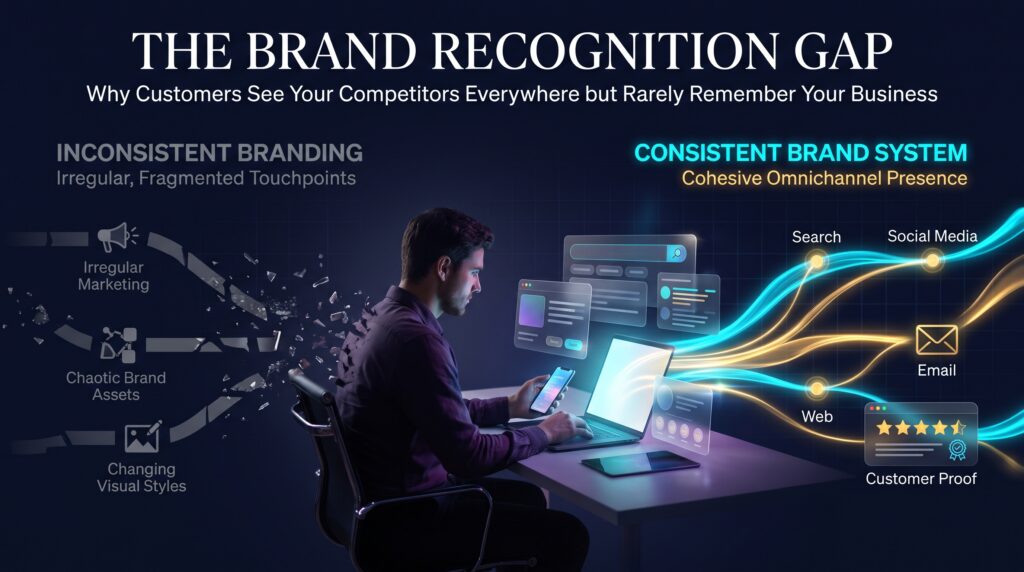

The familiarity advantage is the quiet edge that well-known brands hold over better, but less recognisable, competitors. When a customer is choosing between two options, the one they already recognise often wins, even if the other has a stronger product, a lower price or better reviews. It is frustrating for good businesses, and it is one of the most reliable patterns in how people buy.
The good news is that this effect is not luck and it is not reserved for big advertisers. It is built, piece by piece, through consistent design, repeated exposure and a clear visual identity that people can recognise in half a second. This guide explains why it works, how it shows up in everyday buying decisions, and how designers, marketers and business owners can build it on purpose.
In this guide you will learn:
- What the familiarity advantage is and the psychology behind it
- Why customers choose the known brand even when a competitor is clearly better
- Which design elements make a brand instantly recognisable
- A six-step plan to build a familiarity advantage for your own business
- Which graphic design courses in Australia teach the skills behind recognisable brands
What Is the Familiarity Advantage?
The familiarity advantage describes how recognition shapes preference. Psychologists have studied a related idea since the 1960s, often called the mere-exposure effect: the more often people encounter something, the more positively they tend to view it. Later research on processing fluency suggests a second driver. Things that are easy for the brain to recognise and process feel more trustworthy and more “right”, even when we cannot explain why.
For a buyer, the familiarity advantage works as a mental shortcut. Comparing every option properly takes time and effort, and most people are busy. So the brain leans on signals it already has. Three of them matter most:
- Recognition lowers perceived risk. A known name feels safer than an unknown one, so choosing it feels like a smaller gamble.
- Fluency feels like quality. A clean, consistent look that the brain recognises quickly is read as competent and reliable.
- Memory decides at the moment of need. When a need appears, people consider the brands that come to mind first, and rarely look beyond them.
Why Customers Buy the Familiar Brand Even When Competitors Are Better
Buying decisions are rarely a full comparison
Business owners tend to assume customers weigh features, prices and reviews carefully. In reality, many decisions are quick, partly automatic and made with incomplete information. Familiarity fills the gaps. When a customer cannot easily tell which option is better, they pick the one that feels known.
Familiarity feels like safety
Choosing an unfamiliar provider means risking a bad experience, wasted money or an awkward return. Choosing a recognisable one feels safer because other people have clearly used it before. That feeling of safety is powerful, and it explains why familiarity can outweigh a genuinely superior offer.
Better is hard to judge, known is easy
Quality is often difficult to assess before you buy. A legal service, a trade, a course or a software tool all require trust before the result is visible. Recognition is an easy signal to read, so it quietly stands in for quality. This is the heart of the effect: customers are not ignoring the better option, they simply cannot see that it is better.
Mental availability decides who gets considered
Researchers at the Ehrenberg-Bass Institute describe this as mental availability: how easily a brand comes to mind in buying situations. Brands with strong, distinctive memory cues get considered more often, and a brand that is never considered cannot win, however good it is. Good design is one of the most practical ways to create those cues.
The Familiarity Advantage in Everyday Buying Decisions
You do not need a famous global brand to see the effect. It appears in ordinary local choices every day. The table below shows common situations where recognition tips the decision.
| Situation | Why the familiar option wins | What the better competitor misses |
| Choosing a local tradesperson | The branded van and uniform have been seen around the neighbourhood for years | A strong reputation hidden behind a plain, inconsistent look |
| Picking a café or restaurant | Recognisable signage and cups make it the easy, low-risk option | Great food but a forgettable name and an unclear storefront |
| Hiring an accountant or consultant | A polished, consistent brand signals professionalism before the first call | Excellent skills presented through a rushed, template-style website |
| Choosing a course provider | A name seen in ads, emails and social posts feels established | Better teaching but few memorable brand cues |
| Buying software or an app | Familiar icons and interfaces feel easier to trust and learn | A better product with an unfamiliar, confusing identity |
How Design Builds the Familiarity Advantage
Familiarity needs raw material, and that material is visual and verbal. People recognise brands through a small set of repeated cues. In marketing research these are often called distinctive brand assets. When they are used consistently, each exposure strengthens the last, and the effect grows with every ad, invoice, shopfront and post.
| Brand element | How it builds familiarity | Common mistake |
| Logo and symbol | Becomes the fastest visual shortcut to your business | Redrawing or restyling it for every new project |
| Colour palette | Colour is often recognised before words are read | Using slightly different shades across print and digital |
| Typography | A consistent type voice makes every piece feel connected | Mixing several unrelated typefaces |
| Imagery style | A repeatable photo or illustration look is quickly recognised | Switching styles with every campaign |
| Layout and templates | Familiar structure helps people find information fast | Rebuilding layouts from scratch each time |
| Tone of voice | Consistent wording makes the brand sound like itself | Changing personality between channels |
Notice that none of this is about being flashy. Familiarity rewards consistency and clarity. A modest identity used everywhere will usually outperform a brilliant one used inconsistently. It also pays to protect what you build: IP Australia explains how trade mark registration can safeguard a name or logo that customers have learned to recognise.
Design quality still matters, because a clear, well-crafted look is easier for the brain to process. The Nielsen Norman Group’s overview of the aesthetic-usability effect shows how attractive design can make people more tolerant of minor problems and more willing to trust what they see. In other words, craft and familiarity work together.
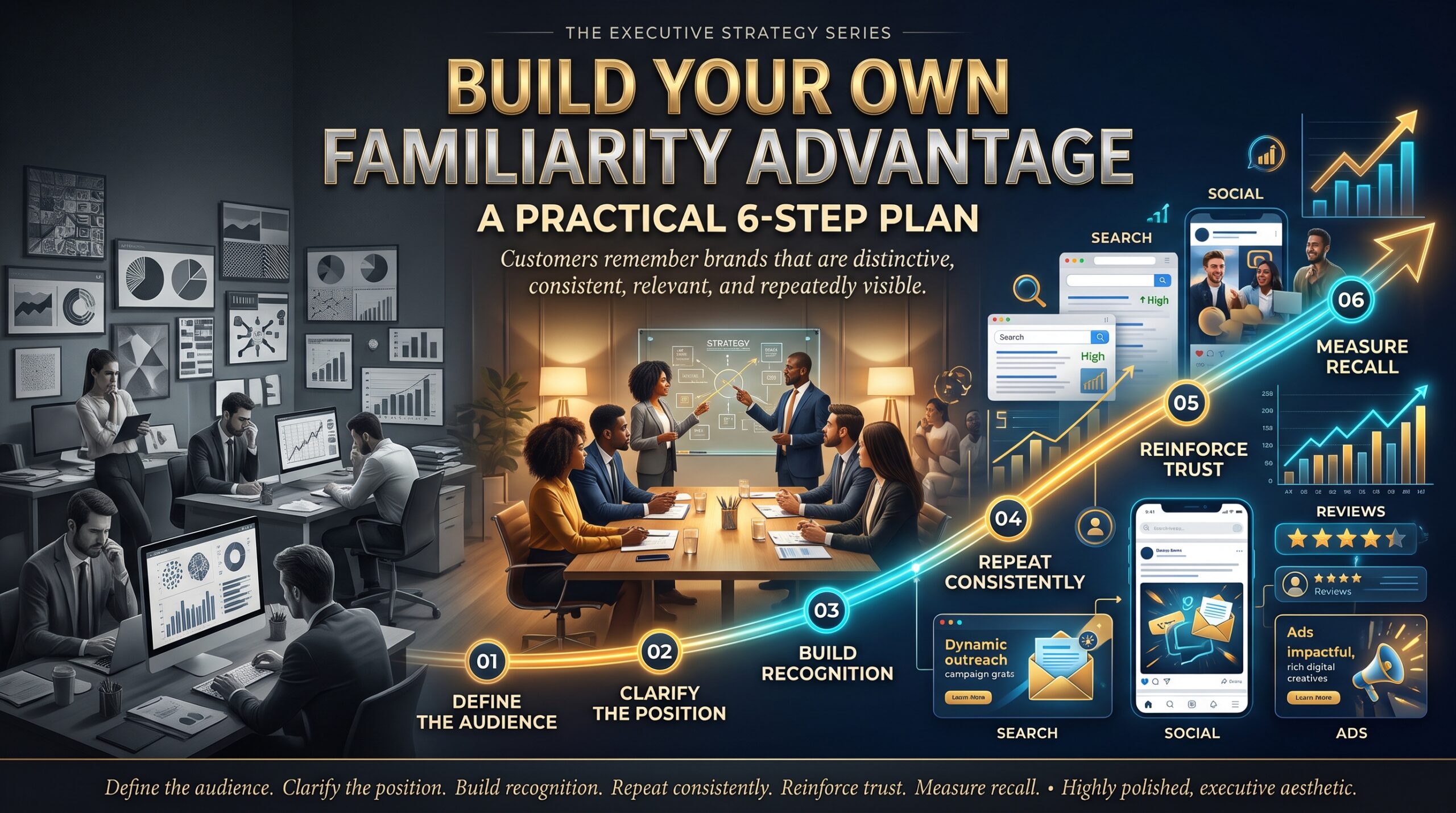
A 6-Step Plan to Build Your Own Familiarity Advantage
If your product is genuinely better than the competition, these steps help customers notice it. None of them need a large budget, but all of them need patience and discipline.
Step 1: Choose your distinctive assets
Pick the handful of visual and verbal cues you want to own, such as a logo, one or two colours, a typeface and a tone of voice. Fewer, stronger cues are easier to remember than a long list.
Step 2: Write simple brand guidelines
Document exact colour values, logo spacing, font sizes and example layouts. A short, clear guide protects the brand when different people produce content.
Step 3: Repeat it across every touchpoint
Use the same look on your website, social posts, email signatures, quotes, invoices, signage and packaging. Familiarity comes from repetition, so every inconsistent piece is a missed opportunity.
Step 4: Show up before the need appears
People buy when a need arises, not when you happen to advertise. Stay visible through steady content, local presence and referrals so your brand is already in memory when that moment arrives. Pairing strong design with smart digital marketing skills keeps your brand in front of the right people.
Step 5: Make the first impression fluent
Clean layouts, readable type and clear hierarchy let people process your brand quickly. A cluttered or confusing design wastes the recognition you have built.
Step 6: Prove quality inside the familiar frame
Once people recognise you, give them reasons to stay. Show testimonials, case studies and results using the same consistent identity, so every good experience strengthens the same set of memory cues. This is how a better product finally turns the familiarity advantage into long-term loyalty.
The Familiarity Advantage Across Australian Cities
The effect is national, but each city has its own competitive texture. The table below is a general illustration, not survey data, with a local page for anyone considering design training.
| City | How the familiarity advantage tends to show up | Local training page |
| Sydney | Crowded markets where hundreds of similar businesses compete for attention | Graphic design courses in Sydney |
| Melbourne | A creative, design-aware audience that notices and rewards distinctive branding | Graphic design courses in Melbourne |
| Brisbane | Fast-growing suburbs where local trades and services build recognition through visibility | Graphic design courses in Brisbane |
| Perth | Strong local loyalty where a familiar name carries extra weight | Graphic design courses in Perth |
| Adelaide | Tight-knit business communities where reputation and recognition travel quickly | Graphic design courses in Adelaide |
| Canberra | Professional and government-linked services where a credible, consistent look builds trust | Graphic design courses in Canberra |
Design Skills That Create the Familiarity Advantage
A recognisable brand is built by people who can turn a strategy into consistent, polished artwork. These are the skills that matter most, and the practical courses that develop them:
- Logo and vector work: build scalable marks and icons with the Illustrator Beginner Course, then progress to the Intermediate and Advanced
- Image editing and campaign visuals: learn retouching, compositing and social graphics in the Photoshop Beginner Course, the Intermediate course and the Advanced course.
- Layouts and consistent documents: create brochures, catalogues and templates in the InDesign Beginner Course, then extend your skills with the Intermediate and Advanced
- All options in one place: browse every graphic design course or check the FAQs before you enrol.
Sessions are instructor-led and hands-on, with weekday, evening and weekend options, and you can study in person in major cities or join live virtually.
Common Mistakes That Weaken the Familiarity Advantage
- Rebranding too often. Each major change resets the recognition you have earned.
- Letting every team member design their own version. Small differences add up to a blurred identity.
- Copying competitors. Looking like everyone else makes you less memorable, not more trusted.
- Relying on a template without adapting it. Generic visuals give customers nothing distinctive to remember.
- Stopping after a short burst. Familiarity is cumulative and needs steady repetition.
- Neglecting small touchpoints. Invoices, email signatures and packaging are brand moments too.
Frequently Asked Questions About the Familiarity Advantage
What is the familiarity advantage in marketing?
The familiarity advantage is the benefit a brand gains when customers recognise it. Recognition makes the brand feel safer, easier to understand and quicker to choose, so it is often picked over a better but less familiar competitor.
Why do customers choose a known brand over a better one?
Because most buying decisions use mental shortcuts. Quality is hard to judge in advance, while recognition is easy to see. Customers use familiarity as a proxy for reliability when they cannot compare every detail.
How long does it take to build a familiarity advantage?
There is no fixed timeline, because it depends on how often and how consistently people see your brand. Small local businesses can build recognition within a community over months, while broader recognition takes longer and steady repetition.
Can a small business compete with bigger, more familiar brands?
Yes. Small businesses can focus on a local area, a clear niche and a consistent identity, which makes them highly recognisable in the places that matter. The effect is relative to your customers’ world, not the whole country.
Do I need a designer to build a familiarity advantage?
You can start with a simple identity and clear guidelines, but skilled design makes recognition faster and more consistent. Many owners and marketers also learn Photoshop, Illustrator and InDesign themselves so they can keep their brand consistent in-house.
Final Thoughts: Be the Brand They Already Know
The familiarity advantage can feel unfair when a better product loses to a better-known one, but it is also an opportunity. Familiarity is something you can build with consistent design, repeated exposure and a clear, distinctive identity. When you pair that recognition with genuine quality, you earn both attention and trust.
If you want to build those design skills, Graphic Design Courses offers instructor-led Photoshop, Illustrator and InDesign training for beginners through to advanced learners, in Sydney, Melbourne, Brisbane, Perth, Adelaide, Canberra and live virtually. Explore the courses, contact the team or call 1300 649 299 to find the right starting point.