

Employers hire less talented designers more often than most creatives are comfortable admitting, and if you have ever lost a role to someone whose portfolio looked weaker than yours, you already know how much it stings. You spent years sharpening your eye. Your layouts are cleaner, your concepts are bolder and your typography is better. Yet the offer went to somebody else.
This is not always unfair, and it is rarely random. When a hiring manager weighs a decision, they are not crowning the most gifted designer in the room. They are trying to avoid a bad hire. This guide explains why employers hire less talented designers, what they are really looking for behind the job ad, and how you can become the safest, smartest choice on the shortlist.
Why Employers Hire Less Talented Designers: Talent Is Only One Part of the Decision
Designers tend to define talent as craft: originality, composition, colour sense and typographic taste. Employers define a good hire as someone who will solve business problems, work smoothly with other people and not create extra work for everyone else. The two definitions overlap, but they are not the same.
Think about what a hiring decision involves. A manager has a deadline, a marketing team waiting on assets and a budget that cannot absorb a mistake. A brilliant designer who misses deadlines, ignores the brief or argues with feedback is a bigger risk than a good designer who is dependable. That is why employers hire less talented designers when the trade-off feels like certainty over brilliance.
The wider research points the same way. The World Economic Forum’s Future of Jobs Report 2025 found that analytical thinking is the most sought-after core skill among employers, followed by resilience, flexibility and agility, and then leadership and social influence. Creative thinking ranked fourth. That survey covers employers across industries rather than design alone, but the message carries over: creativity opens the door, while problem solving, adaptability and collaboration decide who walks through it.
Australian data tells a similar story. Jobs and Skills Australia’s graphic designer occupation profile describes the role as preparing visual content for commercial and communication needs, with particular emphasis on tailoring the message for the intended audience. Notice what is missing from that description: nothing about winning awards.
What Employers Really Look For When They Hire Less Talented Designers
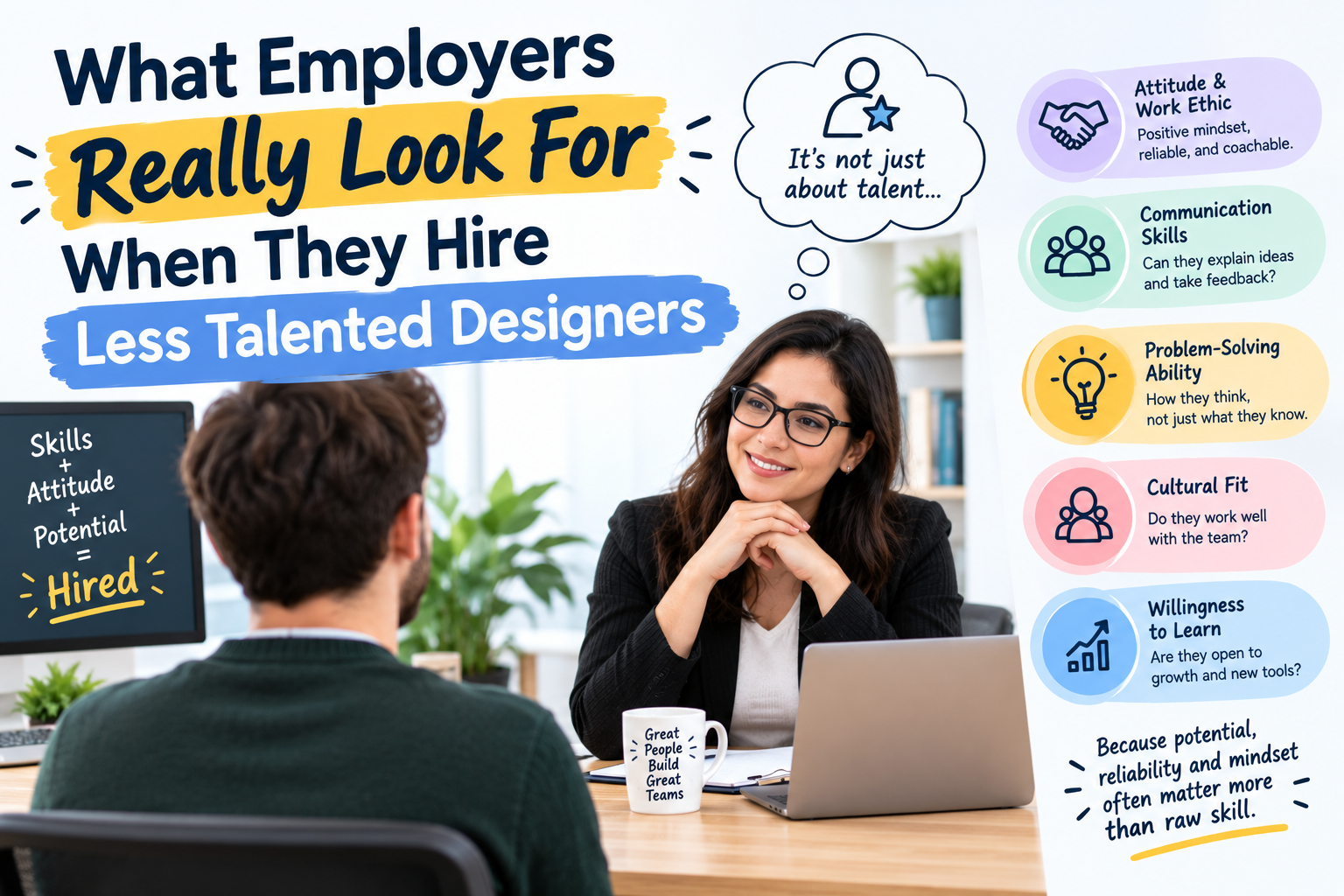
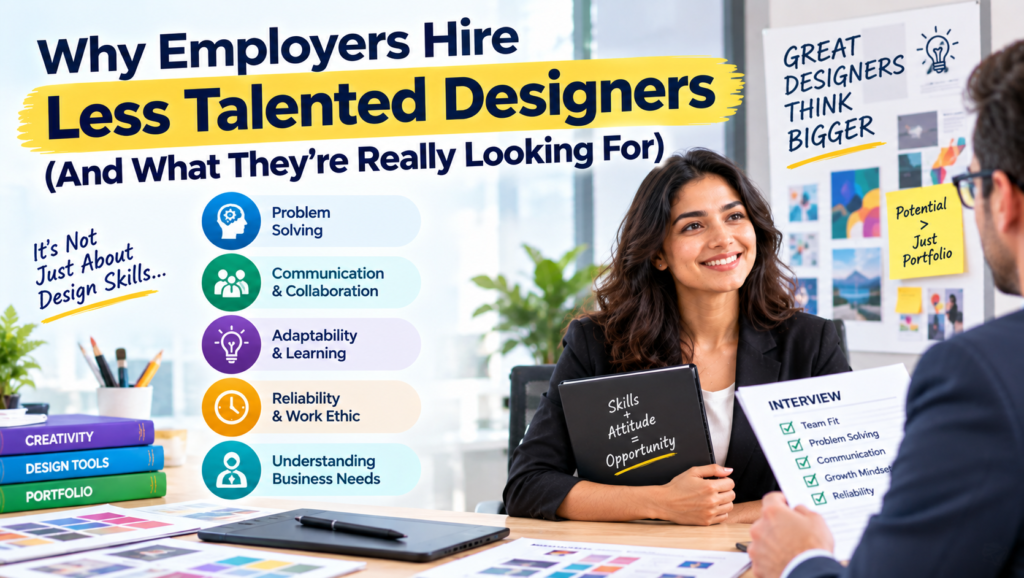
When employers hire less talented designers, they are usually rewarding one or more of the eight qualities below. None of them ask you to lower your standards. They simply ask you to prove more than your talent.
1. They deliver on time, every time
Reliability is the quiet superpower. A designer who sends drafts when promised, flags problems early and never disappears the day before launch saves a manager hours of stress, which is exactly why employers hire less talented designers who are dependable. Employers often ask referees about this before they ask about creativity, so build a track record you can point to and mention it in interviews.
2. They solve the business problem, not just the design problem
A stunning poster that misses the campaign goal is a failed poster. Less flashy designers often win because they ask better questions. Who is the audience? What should they do next? How will we know it worked? This is a common reason employers hire less talented designers who simply understand the goal. Start every portfolio piece with the problem and finish it with the result.
3. They take feedback well
Design is collaborative. Marketing leads, clients and directors will all have opinions, and some of them will be wrong. The designer who listens, asks clarifying questions and revises without drama is far easier to work with than a brilliant one who defends every pixel. In many teams, employers hire less talented designers who take feedback well rather than brilliant ones who resist it. Employers remember how you handled critique during the interview task.
4. They work fast and produce volume
Real jobs are full of resizing, versioning, social media variations and print-ready exports. A designer who can turn around ten solid assets by Friday often beats one who produces a single masterpiece. When employers hire less talented designers, speed is frequently the hidden reason. Practise timed briefs so that pace becomes a strength you can demonstrate.
5. Their files are clean and their software skills are solid
Employers inherit your files. Messy layers, unlinked images, missing fonts and unnamed artboards create rework for the whole team. Strong fundamentals in Adobe Photoshop, Illustrator and InDesign signal that you will fit into a production workflow from day one. Structured training such as the Photoshop Beginner course or the Illustrator Beginner course is an efficient way to close those gaps.
6. They protect the brand instead of expressing themselves
Most in-house and agency roles involve working inside someone else’s brand guidelines. A designer who respects type rules, colour palettes and tone of voice is valuable, while one who keeps reinventing the look creates inconsistency. Brand discipline is another reason employers hire less talented designers with a more consistent touch. Show in your portfolio that you can work within constraints and still produce something fresh.
7. They understand commercial results
Employers love designers who talk about outcomes such as higher click-through rates, better sign-ups and faster approvals. You do not need perfect data. Even a single sentence like “the new layout cut revision rounds from four to two” shows that you understand why the work exists, and it separates you from the candidates who lose out when employers hire less talented designers.
8. They feel like a safe, easy hire
Finally, there is the human factor. Hiring managers choose people they trust: those who communicate clearly, arrive prepared, fit the team and have a reference behind them. Often employers hire less talented designers simply because the candidate felt like the lowest-risk option. You can influence that feeling with a polished LinkedIn profile, a clear portfolio on Behance or your own domain, and a short thank-you email after every interview.
Talent vs Hireability: What Designers Lead With and What Employers Weigh
The table below shows the gap in plain terms. If your application sits on the left side only, you are competing on the one factor employers trust least, and it explains why employers hire less talented designers with stronger right-hand columns.
| What designers often lead with | What employers actually weigh | Proof to show |
| Original, award-style concepts | Does it solve the brief and suit the brand? | Problem, solution and result summary on each project |
| Personal style | Consistency with existing brand guidelines | A case study that works inside a brand system |
| One perfect hero project | Range and speed across everyday tasks | Timed briefs and multi-format asset sets |
| Software list on the CV | Clean, production-ready files | Packaged InDesign files and organised Illustrator artboards |
| Confidence in the work | Openness to feedback | Before-and-after revisions with peer or client comments |
| Portfolio only | Trust and low hiring risk | References, LinkedIn recommendations and prompt follow-up |
How Employers Hire Designers in Sydney, Melbourne, Brisbane, Perth, Adelaide and Canberra
Hiring priorities shift by city and industry. The table summarises patterns we commonly see, so treat it as a guide rather than a rule.
| City | Common employer types | What they often screen for | Skill to sharpen |
| Sydney | Agencies and corporate marketing teams | Speed, brand consistency and multi-format delivery | Photoshop and Illustrator production workflows |
| Melbourne | Studios, retail and e-commerce brands | Strong concepts backed by clear presentation | Illustrator for branding and a polished portfolio site |
| Brisbane | SMEs, in-house teams, tourism and construction | All-rounders comfortable with print and digital | Photoshop, Illustrator and InDesign together |
| Perth | Resources, engineering and professional services | Clear reports, infographics and corporate communication | InDesign for long documents and reports |
| Adelaide | SMEs, education and health organisations | Reliability and versatility | Photoshop retouching and layout basics |
| Canberra | Government departments and agencies | Accessible, compliant, template-driven documents | InDesign templates and consistent layouts |
Whichever city you target, make your portfolio speak the language of local employers. A Brisbane SME wants to know you can produce a brochure and a social campaign in the same week. A Canberra agency wants to see tidy templates and consistent layouts. Understanding that difference is how you avoid being the talented candidate who loses to the more relevant one when employers hire less talented designers with better-matched portfolios.
How to Become the Designer Employers Choose
Here is a practical seven-step plan you can start today without changing your creative style.
- Rewrite your portfolio captions. For each project, state the problem, your solution and the result in three sentences.
- Add one process case study. Show sketches, drafts, feedback and the final outcome so employers can see how you think.
- Clean your files. Name layers, package InDesign documents, organise Illustrator artboards and keep fonts and links together.
- Practise timed briefs. Set a two-hour limit and deliver a full set of assets to prove you can work at a professional pace.
- Prepare feedback stories. Have two examples ready of how you improved a design after criticism.
- Fill skill gaps with structured training. Hands-on Adobe courses build the speed and confidence employers test for. Skill gaps are a frequent reason employers hire less talented designers with cleaner production habits.
- Make yourself easy to trust. Ask past clients or lecturers for LinkedIn recommendations and follow up politely after every interview.
Small changes compound. Once your portfolio shows reliability, speed and results, employers stop asking whether you are talented and start asking when you can begin.
Build the Skills Employers Actually Test
Most design hiring tasks involve at least one of the big three Adobe tools. Graphic Designing Courses offers instructor-led, hands-on training that helps you practise exactly the skills employers screen for. Popular starting points include:
- Photoshop Beginner course: photo manipulation for posters, catalogues, brochures and more.
- Photoshop Intermediate course: enhancing, retouching and manipulating images with more advanced techniques.
- Illustrator Beginner course: an introduction to industry-standard vector illustration.
- InDesign Beginner course: layout and publication design for print and digital.
The Photoshop courses are available in Melbourne, Sydney, Brisbane and live virtually, and the site lists study durations from one day to four weeks. If you are training in Adelaide, Perth or Canberra, Logitrain’s graphic design and Adobe courses run in person in those cities as well as live online. You can also explore the full range on the Graphic Designing Courses homepage.
FAQs: Why Employers Hire Less Talented Designers
Why do employers hire less talented designers over better portfolios?
A portfolio shows craft, not reliability. Employers weigh risk, communication, speed and team fit alongside visual skill, so a candidate who seems dependable can beat a more gifted one. That is why employers hire less talented designers even after seeing stronger work elsewhere.
Is talent overrated in graphic design hiring?
Not overrated, but incomplete. Talent gets your portfolio noticed, while trust, teamwork and business thinking usually decide the final offer.
What do employers look for in a junior graphic designer?
Solid Photoshop, Illustrator and InDesign fundamentals, tidy files, a willingness to take feedback and a portfolio that shows the problem, solution and result for every project.
How can I compete with designers who have more experience?
Show process, not just polish. Add timed projects, packaged files and references. Employers who would normally hire less talented designers because they feel safer will notice a candidate who lowers their risk in the same way.
Which Adobe software should I learn first?
Start with Photoshop for image editing, add Illustrator for logos and vector work, then learn InDesign for layouts and documents. Many roles expect at least two of the three.
Talent Gets You Noticed. Trust Gets You Hired.
If employers hire less talented designers, it is rarely because they missed your brilliance. It is because someone else made the decision feel safer. You do not need to become a lesser designer to win. You need to add reliability, communication, speed and clean production skills to the talent you already have. Ready to build the Adobe skills employers test? Explore our graphic design courses and take the next step.