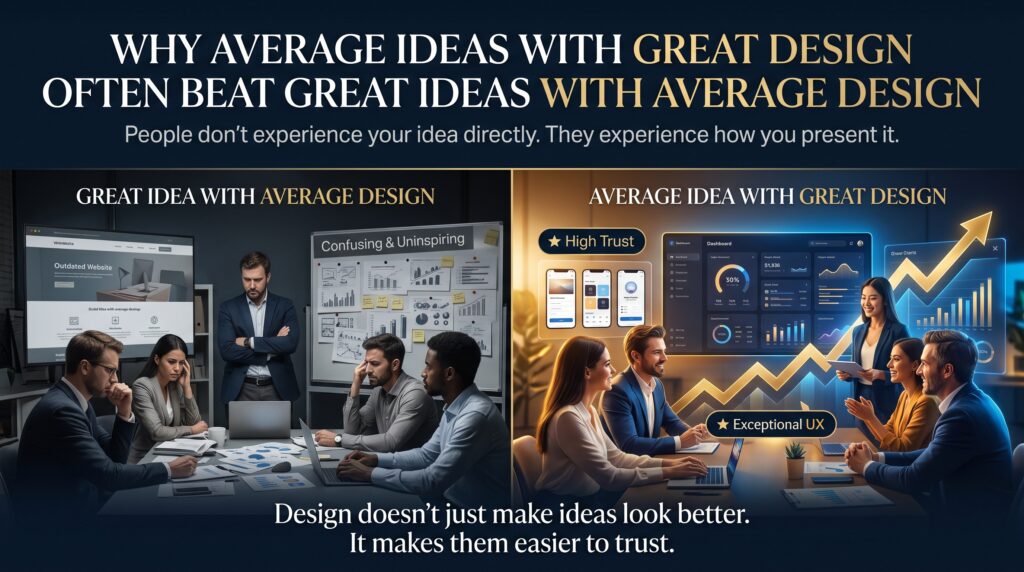

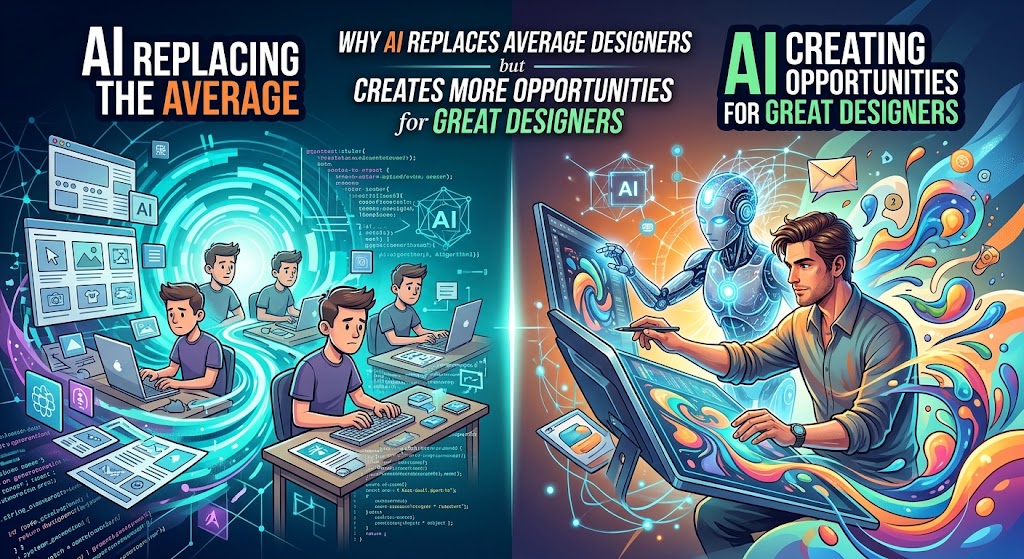

Will AI replace graphic designers? It is the question filling design Facebook groups, LinkedIn feeds and university corridors right now, and the honest answer sits somewhere between panic and denial. AI will replace a lot of average design work. It will also create more opportunities, and better-paid ones, for designers who think, judge and solve problems rather than simply push pixels.
Maybe you are a student in Melbourne wondering whether graphic design is still worth studying. Maybe you freelance in Brisbane and have watched a client paste a prompt into Canva instead of calling you. Or you are a marketer in Sydney deciding who to hire next. This guide is written for all three of you. We will look at what generative AI actually does well, where it falls over, what “average” really means in a design career, and how to land on the right side of that line. In short, will AI replace graphic designers who keep learning? Probably not, and the rest of this article explains why.
Will AI Replace Graphic Designers? The Short Answer
No, AI will not replace graphic designers as a profession. It is already replacing the repetitive, templated, low-judgement end of the job, though. Tools such as Adobe Firefly, Midjourney and Canva’s AI features can produce a passable social tile, remove a background or generate a dozen logo-style concepts in under a minute. When a client’s brief is “make it look nice, cheap and fast”, software now competes seriously with a junior designer who only follows instructions.
But design was never only about producing visuals. It is about deciding what a visual should do. Designers whose value sat in the deciding are getting busier. Designers whose value sat only in the producing are feeling the squeeze. That split is the whole story.
We have seen this pattern before. Desktop publishing did not kill designers; it ended typesetting as a separate trade and raised the bar for everyone left standing. Digital photography, stock libraries and website templates each removed a layer of grunt work and rewarded the people who could think on top of it. AI is the biggest version of that wave so far, and it is moving faster.
What AI Already Does Well (and Why Average Work Is Exposed)
Before you decide how worried to be about whether will AI replace graphic designers like you, it helps to be realistic. Right now, generative AI is genuinely good at:
- Fast variations: dozens of colour, layout and style options generated in minutes instead of hours.
- Image creation and editing: generative fill, background and object removal, upscaling and quick retouching inside tools like Photoshop.
- Template-driven content: simple social posts, basic flyers and resized ad sets across multiple formats.
- First-draft thinking: mood boards, rough concepts and placeholder copy to get a project moving.
- Repetitive production: batch exporting, resizing and routine clean-up work.
If most of your week looks like that list, and your main value is speed at carrying out someone else’s instructions, you are competing with software that never sleeps, never invoices and improves every few months. That is uncomfortable to hear. It is also useful, because it tells you exactly where to invest your time.
Who Counts as an “Average Designer”?
“Average” here has nothing to do with talent, age or whether you went to university. It describes a way of working. In practice, an average designer is someone who:
- Follows trends instead of interpreting the brief.
- Knows where the buttons are in Photoshop or Illustrator, but not why a layout works.
- Delivers one option and defends it with “I just liked it”.
- Never asks about the audience, the budget or the business goal behind the job.
- Builds a portfolio of class projects that look like everyone else’s.
It is a habit, not a label on a person. Every great designer started here. The difference is whether you stay.
Why Great Designers Will Have More Opportunities, Not Fewer
Strategy and judgement cannot be prompted
AI will hand you a hundred options. Someone still has to choose one, and defend that choice against a brand, an audience and a commercial goal. Clients pay for that call. The more options AI produces, the more valuable a person with good taste and clear reasoning becomes. This is why “will AI replace graphic designers?” is only half the question; the better one is which designers will thrive.
Brand consistency needs a human hand
AI output drifts. One image has the right mood, the next one looks like it belongs to a different company. Holding typography, colour, tone and layout together across a website, packaging, signage, video and print is a craft skill, and it is one of the main reasons businesses hire designers rather than just buy subscriptions.
Cultural context and human insight matter in Australia
A campaign for Perth tradies reads differently from one for Canberra policy teams or Melbourne hospitality. Local humour, accessibility needs and cultural sensitivity, including how Aboriginal and Torres Strait Islander imagery is handled, require human judgement and real conversations. A model trained on global images does not know your client’s customers.
Print-ready, production-ready and risk-aware work
Bleed, CMYK versus RGB, file preparation, accessibility and licensing are not glamorous topics, but they are where jobs go wrong. Questions around copyright and commercial use of AI-generated images are still unsettled, so businesses want designers who understand the risks and can document how an asset was made.
The total amount of design work is growing
Every business now needs more content, on more channels, more often. AI lowers the cost of each asset, so volume goes up, and volume needs direction. The World Economic Forum’s Future of Jobs Report 2025 points to creative thinking and technological literacy among the skills employers expect to grow in importance, which is exactly where strong designers sit. For local occupation trends, Jobs and Skills Australia is worth checking before you plan your next move.
New Roles and Opportunities AI Is Creating for Designers
Even while people argue about will AI replace graphic designers, new job titles keep appearing. Some are still settling, but the work behind them is real and already being advertised:
- AI-assisted visual designer: produces finished campaign assets faster by combining Adobe tools with generative features.
- Brand systems designer: builds the rules, templates and guidelines that keep AI and human output on-brand.
- Creative director for AI-assisted teams: briefs, curates and edits machine output the way a director guides a crew.
- Social and motion content designer: turns static concepts into short-form video and animated assets at scale.
- UX and UI designer: designs how people actually use products, an area where research and empathy count most.
- Freelance design consultant: helps small businesses use AI tools safely, consistently and legally.
Will AI Replace Graphic Designers? Average vs Great Designers Compared
| Area | Average designer | Great designer |
| Use of AI | Copies the first output | Directs, edits and improves the output |
| The brief | Takes it at face value | Questions it and finds the real problem |
| Output | One polished option | Several reasoned options with a recommendation |
| Client conversation | Talks about software and style | Talks about goals, audience and results |
| Portfolio | Class projects and templates | Process, decisions and measurable outcomes |
| Learning habit | Learns a tool once | Keeps updating skills every few months |
| Career outlook | Competes on price and speed | Competes on judgement and trust |
Where the Opportunities Are: Design Careers Across Australian Cities
The question “will AI replace graphic designers?” gets a different answer depending on where you live. Here is a general snapshot of the sectors that tend to hire visual communicators in each major city, along with local training options.
| City | Typical design demand | Training |
| Sydney | Agencies, finance, retail, media and corporate marketing teams | Graphic design courses Sydney |
| Melbourne | Creative studios, publishing, fashion, hospitality, arts and education | Graphic design courses Melbourne |
| Brisbane | Tourism, events, property, startups and in-house marketing | Graphic design courses Brisbane |
| Perth | Resources, engineering, corporate communications and tourism | Graphic design courses Perth |
| Adelaide | Health, education, defence-related industries and local agencies | Graphic design courses Adelaide |
| Canberra | Government communications, policy, universities and associations | Graphic design courses Canberra |
Not near a major city? Live virtual and in-house options are also available, so location should not stop you from building these skills. You can see every option on the graphic design courses locations page.
7 Ways to Become the Designer AI Cannot Replace
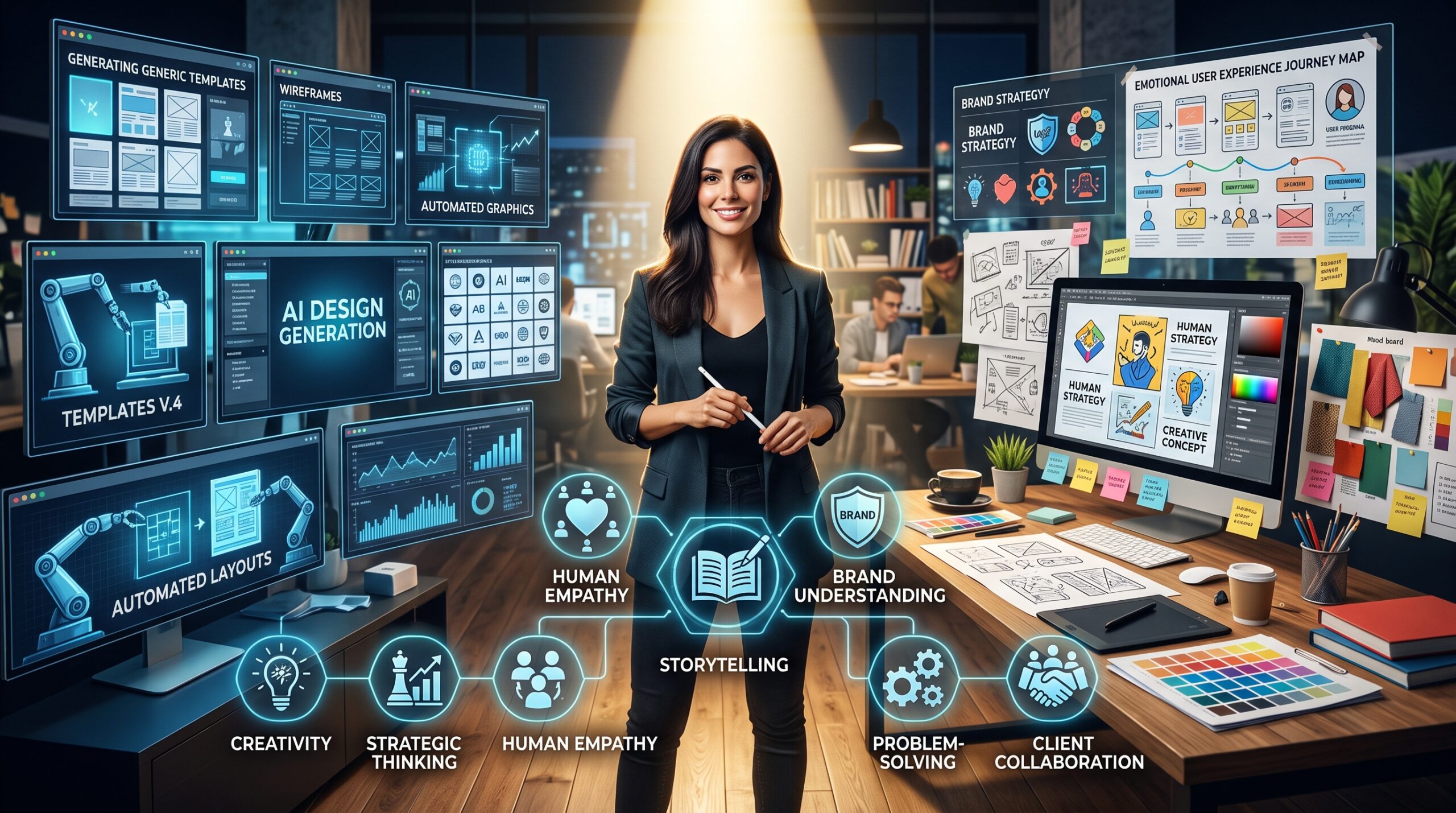
If you are still asking will AI replace graphic designers like you, these seven habits are the best insurance you can build.
- Master the fundamentals. Typography, hierarchy, colour, spacing and composition are what let you judge AI output instead of just accepting it.
- Get fluent in industry-standard tools. Generative features now live inside Adobe software, so knowing Photoshop, Illustrator and InDesign properly gives you control that a prompt box does not.
- Use AI as a collaborator, not a crutch. Lean on it for ideas, variations and tedious retouching, then apply your own edit before anything reaches a client.
- Think like a strategist. Ask what the design needs to achieve, who it is for and how success will be measured. Even a basic understanding of digital marketing makes your design more valuable.
- Pick a niche. Packaging, healthcare, hospitality, education or tech; specialists are harder to replace than generalists.
- Show your process in your portfolio. Include the brief, rejected ideas, reasoning and results. Our blog covers portfolio building in more detail.
- Keep learning on a schedule. Tools change quickly. Set aside regular time every quarter to learn new features and test them on real projects.
Learn the Tools That Sit Underneath the AI
Generative AI works best in the hands of someone who already understands layers, vectors, grids and print production. If you want that foundation, these instructor-led courses are a practical place to start:
- Photoshop: beginner, intermediate and advanced for photo editing, compositing and image manipulation.
- Illustrator: beginner, intermediate and advanced for logos, icons and vector graphics.
- InDesign: beginner, intermediate and advanced for brochures, catalogues and multi-page layouts.
You can compare all levels on our graphic design courses page, or learn more about us before you decide.
Frequently Asked Questions
Will AI replace graphic designers completely?
Very unlikely. AI is taking over routine production tasks, but clients still need people to interpret briefs, protect a brand, make decisions and take responsibility for the final result. The role is changing shape rather than disappearing.
Will AI replace graphic designers who are just starting out?
It will replace beginners who only offer basic template work, but it also opens doors for newcomers who learn the fundamentals and AI-assisted workflows early. Starting now, with the right training, puts you ahead of many people who are waiting to see what happens.
Is graphic design still a good career in Australia?
Yes, for people who build strong fundamentals and adapt. Entry-level work that was purely mechanical is under pressure, but demand for designers who combine creative judgement, software skills and an understanding of marketing is holding up and, in many areas, growing.
Which graphic design skills are safest from AI?
Strategic thinking, brand systems, art direction, typography, client communication, UX research and print production knowledge. These all depend on context, taste and accountability, which are hard to automate.
Should I still learn Photoshop and Illustrator if AI can generate images?
Yes. Professional work requires precise control, editing and file preparation that prompts alone cannot deliver. Knowing the tools also helps you spot flaws in AI output and fix them quickly.
How can a beginner start a design career with AI in the picture?
Learn the fundamentals first, then pick up one Adobe tool at a time. Build three to five portfolio projects that show your thinking, and use AI to speed up parts of the process without letting it make your decisions. A structured beginner course can shorten that path considerably.
What do employers want from designers now?
Reliability, clean files, brand awareness, the ability to take feedback and a clear link between design choices and business outcomes. AI literacy is increasingly expected, but it sits on top of these basics rather than replacing them.
The Bottom Line
So, will AI replace graphic designers? It will replace the average version of the job: the template-follower, the button-pusher and the designer who never asks why. It will also give great designers more reach, more clients and more interesting work than before. The gap between those two groups is widening, and the good news is that crossing it is a matter of skills, habits and practice rather than luck.
Still asking will AI replace graphic designers who keep learning? The best answer is to build skills that hold their value. Explore our graphic design courses in Australia or contact our team to find the right level and location for you. You can also see wider training options at Logitrain.