


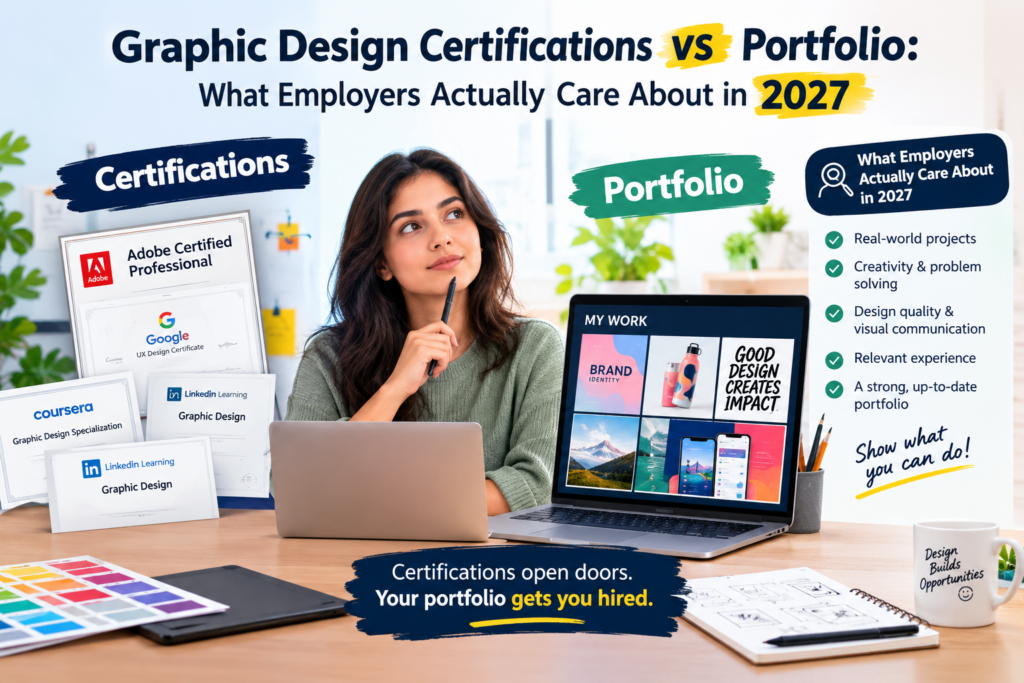
Ask ten designers whether graphic design certifications vs portfolio matters more and you’ll get ten different opinions, but hiring managers across Sydney, Melbourne, Brisbane, Perth, Adelaide and Canberra are fairly consistent: they open the portfolio first. That doesn’t mean certifications are worthless it means they play a different role in the hiring decision than most job seekers assume. This guide breaks down exactly what each one proves, and how to use them together to actually get hired.
What a Portfolio Proves That a Certification Can’t
A portfolio is direct evidence of taste, execution and problem-solving three things a certificate can’t demonstrate on its own. When a Melbourne creative agency or a Sydney in-house marketing team reviews applications, the portfolio answers the only question that ultimately matters: can this person produce work our brand would be comfortable publishing. A design certification tells an employer you understand tools and principles; a portfolio tells them you can actually apply both under real constraints.
What a Certification Still Proves That a Portfolio Can’t
A portfolio shows finished output, but it doesn’t prove you understand software efficiently, follow a structured design process, or can pick up an unfamiliar brief without months of trial and error. This matters most for two groups: candidates with no industry experience yet, where a certification is the only concrete signal of software competency, and candidates targeting more technical or production-heavy design roles (packaging, UI/UX, print production) where tool fluency genuinely gets tested.
Where Employers Actually Look First in 2027
Junior and Entry-Level Roles
What matters most:
For junior roles, employers in Brisbane and Perth typically screen the portfolio first for taste and consistency, then check for a relevant certification (such as Adobe Certified Professional) as a secondary confidence signal, especially when the candidate has no prior paid design work to point to.
Mid-Level and Senior Roles
What matters most:
By mid-career, the portfolio does almost all of the work employers assume software competency by this stage and instead look for range, client variety, and evidence of design thinking across different brands or problems. A certification rarely comes up in these interviews at all.
Freelance and Client-Facing Work
What matters most:
Clients hiring freelance designers across Sydney and Melbourne almost never ask about certifications they want to see a portfolio that matches their industry or aesthetic, plus testimonials or reviews. Certifications matter more for landing your first agency or in-house role than for freelance client trust.
Government and Large Corporate Roles
What matters most:
Canberra government and large enterprise employers are the exception some formally require a certification or diploma as part of a structured hiring process, even when the portfolio is strong, simply because of internal HR requirements around minimum qualifications.
How to Use Both Together (The Approach That Actually Works)
- Build your portfolio first, even with self-directed or spec projects, since it’s the primary screening tool for almost every role.
- Add a recognised certification once you have 4–6 strong portfolio pieces, to reinforce (not replace) what the work already shows.
- Name your certification briefly on your resume and LinkedIn, but never let it substitute for showing actual work.
- For government or large corporate applications specifically, check the job ad for a formal qualification requirement before you apply.
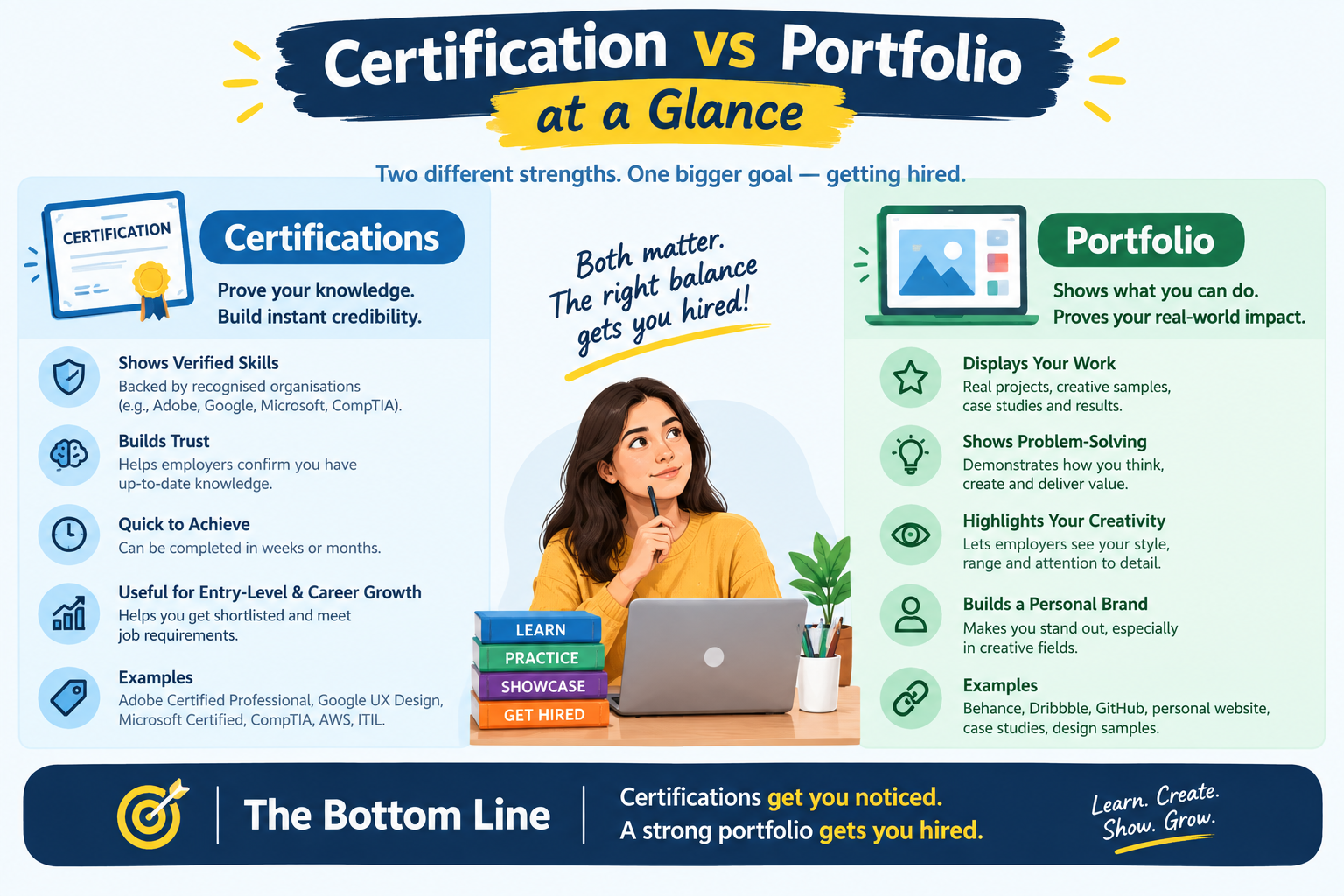
Certification vs Portfolio at a Glance
| Factor | Portfolio | Certification |
| Proves | Taste, execution, problem-solving | Tool competency, structured process knowledge |
| Matters most for | Every stage, especially mid-to-senior roles | Entry-level roles and formal HR requirements |
| Checked first by | Creative agencies, in-house teams, freelance clients | Government and large corporate HR screening |
| Best used | As your primary proof of ability | As supporting evidence alongside a strong portfolio |
Certifications and Courses to Build Both at Once
The fastest path into the industry combines the two rather than choosing one a structured course gives you a recognised certification and a set of real, portfolio-ready projects to show at the same time, rather than treating them as separate goals.
- Start with a Graphic Design Course that builds both a certification and real portfolio pieces as you go.
- Explore the full IT and creative skills training catalogue at Logitrain, Australia’s long-established training provider.
Further Reading
- Current graphic design job vacancies across Australia on SEEK.
- Official Adobe Certified Professional pathway details from Adobe.
Final Tips Before You Apply
- Lead every application with your strongest portfolio pieces, not your certifications list.
- Tailor the portfolio pieces you show to the specific role and industry you’re applying to.
- Only invest in a certification once you know it’s genuinely valued for the type of role you’re targeting.
Ready to build a portfolio and certification that actually get you hired? Explore the full Graphic Design Course at graphicdesigningcourses.au and build real, job-ready projects alongside a recognised certification training available for candidates across Sydney, Melbourne, Brisbane, Perth, Adelaide and Canberra.